
 Back to Insights Hub
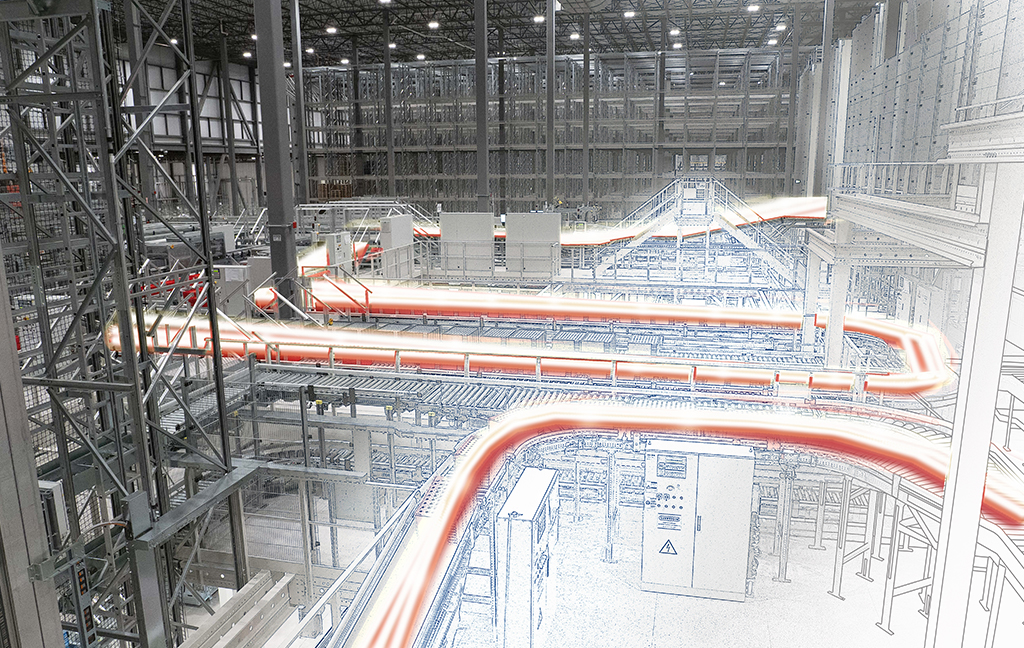
The supply chain has become one of the most powerful levers of financial performance. Rising product complexity, omnichannel growth, labour constraints, and volatile transportation markets require retailers to rethink how products move, where capacity sits, and which processes can and should be automated.
Strategic Network Design provides the blueprint. It clarifies where to position nodes, how to allocate inventory, what flows should be centralized, and which technologies will future-proof operations. It also establishes a long-term capital plan, ensuring that growth does not come with incremental inefficiency or unnecessary cost.
This paper outlines how leading retailers use segmentation, Service-Level-Agreements (SLA), data-driven flow modelling, warehouse design, and in some cases automation technologies such as Witron, to build a scalable, financially resilient distribution network.
Why Network Strategy Is a Board-Level Priority
A response to structural shifts reshaping supply chains. Retailers are facing long-term pressures that legacy network designs were never built for. A modern strategy must address these structural forces:
- Rising Service Expectations – Competition has shifted toward service, broader assortments, faster fulfillment, and near-instant availability across channels, placing unprecedented strain on existing networks.
- Labour Market Constraints – Labour availability continues to tighten, wage costs are increasing, and labour-related disruptions are becoming more frequent. In some cases, automation can provide predictable throughput and operational continuity independent of labour volatility.
- Demand, Product, and Channel Complexity – Omnichannel acceleration, product proliferation, and variable demand profiles create flow patterns that exceed the capacity and flexibility of traditional networks.
- Rising Transportation and Real Estate Costs – Urban congestion, carrier rate inflation, and land scarcity increase the financial penalty for inefficient node placement and outdated facility design.
- Capital Allocation Discipline – Executives must justify long-horizon investments with scenarios, business cases, and Return on Investment (ROI) clarity. Network strategy provides the insight needed to prioritize where and when to deploy capital and where not to.

The Role of Product & Flow Segmentation
Credible network modelling and long-term capital decisions depend on segmentation. Without it, network design relies on averages that obscure true cost, capacity constraints, and service risk.
Segmentation ensures that network strategy reflects actual operational complexity: by product, channel, and flow, rather than simplified assumptions. When applied correctly, segmentation enables:
- Precise growth assumptions by product hierarchy, channel, and fulfillment mode
- Inventory strategies aligned to source, supplier reliability and demand variability
- Flow-path decisions based on velocity, volatility, seasonality, and service expectations
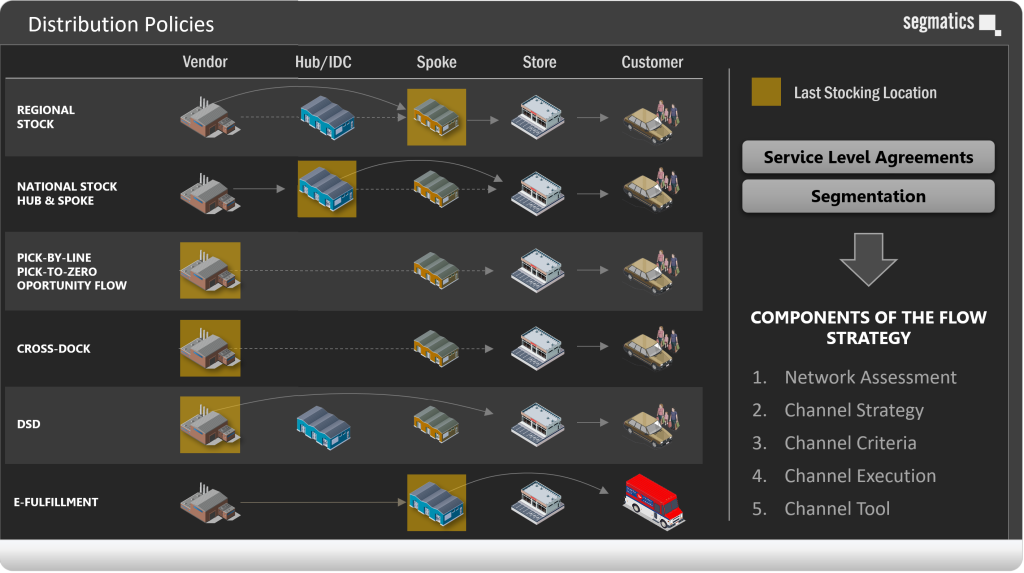
Segmentation also plays a critical role inside the distribution centre:
Automation feasibility driven by product characteristics such as unit-of-handling, dimensions, weight, case integrity, and packaging consistency
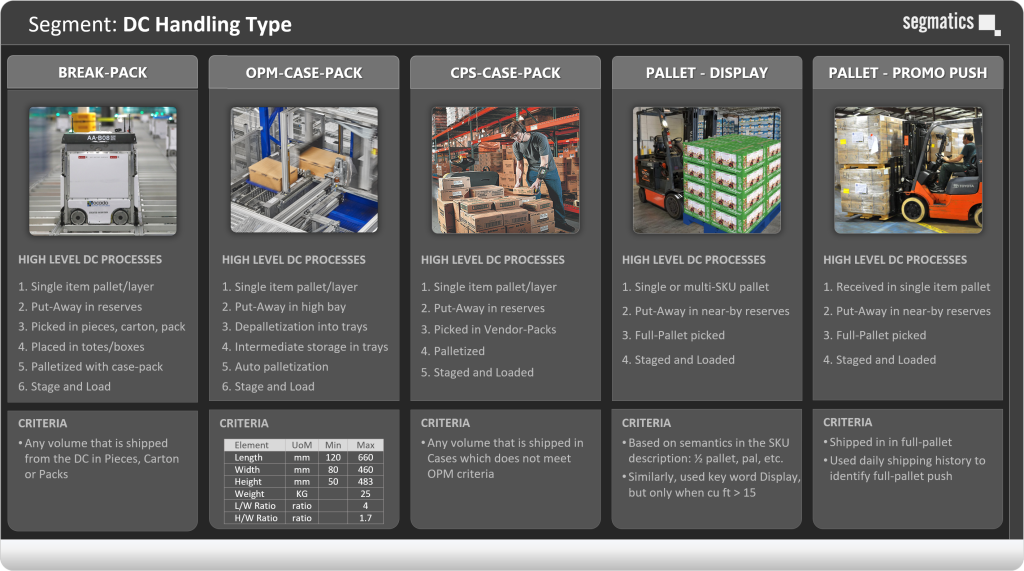
Understanding these differences is essential for designing layouts, defining process paths, and determining which flows are viable candidates for mechanization or automation.
For the C-suite, segmentation delivers something essential: confidence in the numbers.
It ensures that growth projections, capacity requirements, service trade-offs, and capital investments are grounded in operational reality—reducing execution risk and improving the quality of strategic decisions.
How Strategic Network Design Is Executed
Strategic Network Design is a structured, data-driven process that supports long-term financial and operational planning. It synthesizes enterprise data, operational insight, automation expertise, and strong Project Management Office (PMO) discipline into a cohesive, executable roadmap.
Phase 1 — Data Preparation & Assumptions Alignment
This phase establishes a single, trusted version of the truth and ensures early alignment across stakeholders.
- Align demand, inventory, cost, and inflation assumptions with Finance and Supply Chain
- Consolidate all data sources: transactional, master, financial, rate cards, productivity
- Build year-by-year throughput projections (cases, layers, pallets) by segment and channel
- Validate assumptions early with leadership to avoid rework and downstream delays
Phase 2 — Scenario Modelling
Scenario modelling evaluates structural choices and quantifies trade-offs across service, cost, and resilience.
- Evaluate the optimal number, size, and location of Distribution Centres (DCs)
- Quantify service, cost, and resilience across configurations
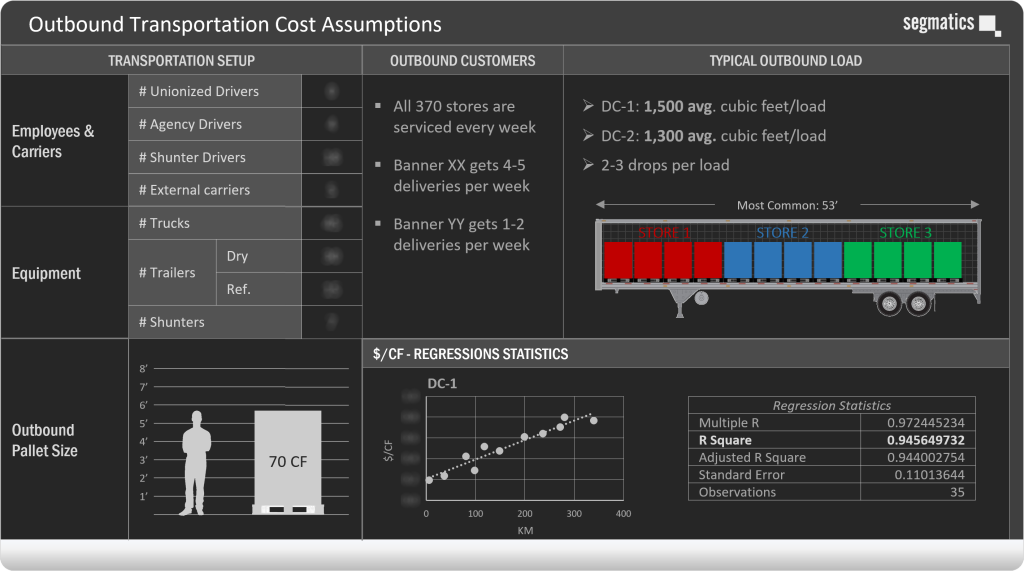
- Integrate inbound, inter-DC, and outbound transportation modelling
- Identify how each scenario performs under growth, demand shifts, and risk events
- Optimize routing and distribution modes (vans, straight trucks, long-haul)
Phase 3 — DC Design: Conventional & Automated
Once preferred scenarios are identified, facilities are translated into executable designs
- Assess land availability, zoning requirements, and site-specific constraints
- Size storage, docks, yards, equipment, and labour requirements
- Evaluate throughput capability, high-level costs, storage density, and technical feasibility
- Assess high warehouse-flow capture scenarios to reduce third-party logistics (3PL) reliance
Phase 4 — Implementation Planning
The final phase converts strategy into an actionable delivery plan
- • Define the full project lifecycle: permitting → construction → installation → ramp-up
- Ensure service continuity and availability throughout network transitions
- Address workforce requirements and labour-market constraints
- Identify system, IT, and organizational dependencies that influence timelines and risk
Phase 5 — Business Case & Financial Model
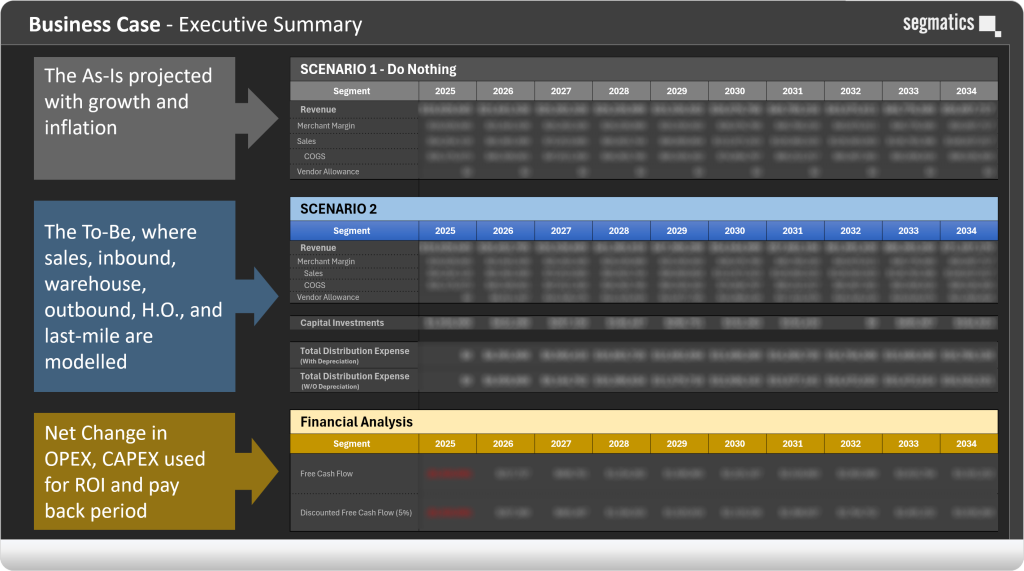
Phase 5 translates network and facility scenarios into a decision-grade financial business case. Each option, Baseline (do nothing), Conventional, sometimes Hybrid, and Automated, is evaluated using a consistent framework aligned with Finance and the supply chain general ledger:
For each scenario, the analysis includes:
- Operating Expenses (OPEX)
Labour, occupancy, maintenance, administration, transportation, utilities, and depreciation - Capital Expenditures (CAPEX)
Land acquisition, construction, automation systems, material handling equipment (MHE), and IT - Financial Performance Metrics
EBITDA impact, payback period, Return on Invested Capital (ROIC), 20-year cash flows, and Discounted Cash Flow (DCF) analysis - Risk Assessment
Labour availability, technology and integration risk, land and permitting constraints, and operational complexity
The output is a credible, board-ready financial roadmap—linking operational design choices to capital allocation, returns, and risk—rather than a standalone engineering proposal.
Warehouse Automation – A targeted solution to specific operational and financial problems
Warehouse automation is not a one-size-fits-all solution. Its value depends on network structure, product characteristics, labour availability, service requirements, and long-term volume certainty. When deployed selectively and aligned to clearly defined problems, automation can create a durable structural advantage. When misapplied, it can introduce rigidity, excess capital risk, and operational complexity.
Levels of automation maturity
Automation spans a broad spectrum, from targeted productivity enhancements to fully integrated, end-to-end systems. Common levels include:
- Point solutions
Pick-to-light, goods-to-person, Autonomous Mobile Robot (AMRs), conveyors, palletizers, and depalletizers. These solutions address specific bottlenecks, reduce labour in targeted processes, and provide flexibility with relatively low capital risk. - Hybrid automation
Partial automation integrated into conventional facilities, such as automated pallet handling, shuttle systems, or high-density storage for select flows. These solutions balance flexibility and capital efficiency while improving throughput and space utilization. - Fully integrated automation
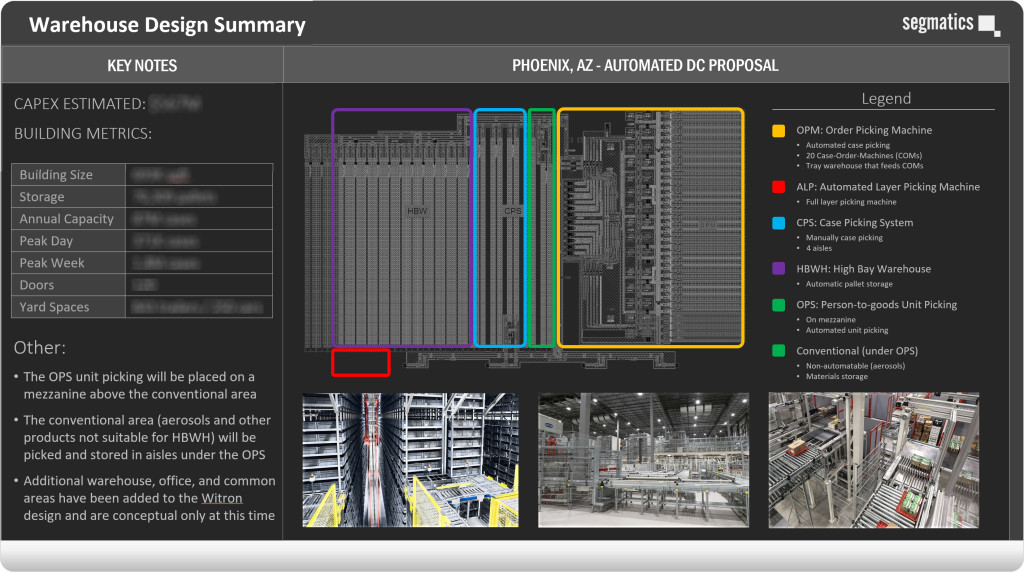
End-to-end systems that integrate inbound handling, storage, picking, sequencing, and outbound consolidation. Solutions such as Witron represent the most comprehensive form of automation, delivering highly predictable throughput, consistent store-ready pallets, and significant labour displacement—at the cost of higher capital intensity and reduced flexibility.
Financial framing matters
Automation should never be evaluated in isolation. It must be benchmarked against a credible conventional or hybrid baseline and assessed using:
- Total cost-to-serve
- Long-term labour exposure
- Service consistency and execution risk
- Capital productivity and ROIC
When applied selectively, automation shifts cost structures from variable to predictable—stabilizing EBITDA and reducing long-term operational risk. When applied indiscriminately, it can erode flexibility, inflate capital exposure, and undermine returns
How Network Design Ties Into C-Suite Priorities
Strategic Network Design provides a clear translation from supply chain strategy to shareholder value. Decisions around network structure, inventory placement, and automation directly shape financial performance, resilience, and capital productivity.
Revenue & Market Share
- Improved availability reduces stockouts and protects topline revenue
- Higher pallet and store-ready quality improves in-store execution and on-shelf visibility
EBITDA & Margin Expansion
- Reduced warehouse labour dependency and fewer store touches stabilize cost curves
- Fewer transfers, fewer expedites, and lower shrink reduce structural operating costs
Working Capital & Cash Flow
- Centralized and segmented inventory strategies reduce safety stock and days on hand
- Optimized inbound and outbound flows minimize capital trapped in transport and storage
Risk & Business Continuity
- Reduced exposure to labour availability risk and labour-related disruptions
- Distributed and right-sized capacity lowers the risk of operational interruption
ROIC & Capital Productivity
- All investments are benchmarked against a validated conventional baseline
- Ensures every dollar of CAPEX generates measurable financial uplift—not just operational improvement
Conclusion
A modern network strategy is fundamentally a financial strategy. When executed rigorously, it improves availability, lowers cost-to-serve, strengthens resilience, and enhances capital productivity.
By integrating segmentation, disciplined network modelling, selective automation, and strong PMO governance, retailers can build a supply chain that:
- scales efficiently
- strengthens resilience
- supports long-term growth
- stabilizes EBITDA
- maximizes return on invested capital
In an environment defined by volatility and capital scrutiny, network design becomes one of the most powerful levers the executive team can pull.