 Back to Insights Hub

Advanced Forecasting and Replenishment (F&R) systems have become foundational for retailers that want to remain competitive in a rapidly evolving retail environment. When implemented well, these platforms generate accurate sales forecasts across millions of product–customer combinations, automate replenishment decisions, and maintain optimal inventory levels with far less exposure to human error.
Their impact extends far beyond the supply chain. High-performing F&R systems strengthen top-line sales through improved availability, enhance cash flow by reducing unproductive inventory, and lower the cost-to-serve through coordinated decision-making across the business. They create a unified analytical foundation that synchronizes merchandising calendars, vendors’ Sales and Operations Planning (S&OP), logistics constraints, and store-labor requirements, ensuring that operational plans remain aligned with budgets.
This whitepaper outlines the capabilities retailers should expect from modern F&R technologies such as SAP F&R and SAP CAR Unified Demand Forecast (UDF). It also describes the organizational maturity required for success, the pitfalls that commonly derail implementations, and the roadmap that retailers follow to build a modern, forecast-driven operating model.
System Capabilities Retailers Expect from Modern F&R Technologies
To determine the requirements for a forecasting and replenishment platform, retailers must understand their current gaps and align internally on what modern systems enable financially and operationally. At a high level, capabilities fall into three categories: the F&R engine, the integration layer, and the user experience.
A modern F&R engine must generate reliable statistical forecasts at scale, automatically correcting historic sales for promotions, stockouts, weather, and other distortions. With seasonality, trend, and lifecycle modelling applied, modern systems produce a stable baseline forecast for every product–customer combination, creating a consistent foundation for buying decisions across planners.
The integration layer ensures that the forecast reflects the full business plan. Promotional calendars, new-product introductions (NPIs), vendor capacity, logistics constraints, and local demand signals must flow on top of the baseline forecast seamlessly. When the ecosystem is well connected, the forecast becomes the single source of truth to plan inventory, labour, and supply-chain resources, reducing firefighting, unplanned spending, and margin erosion.
Once the total demand forecast is established, the replenishment logic applies lead times, delivery frequencies, minimum presentation stock, and other parameters to automate ordering with minimal human intervention. When the engine performs well, retailers protect sales, improve inventory turns, and free working capital previously tied up in excess stock.
Finally, the user experience determines how effectively teams execute the plan. Demand and replenishment planners focus only on exceptions, supported by intuitive interfaces, real-time KPIs, and workflows that highlight the small subset of products that materially influence sales, service levels, and capital efficiency. Modern systems allow for easy exchange of demand and replenishment plans across the business, helping teams to plan the necessary resources to fulfill demand.
Advanced & Customized Capabilities
Modern retailers often require capabilities beyond the standard engine. For slow-velocity assortments, specialized logic prevents chronic over-buying when demand is measured in decimals, a common limitation of legacy systems that leads directly to excess inventory and tied-up capital.
Retailers with multi-echelon networks, national and regional Distribution Centres (DCs), hub-and-spoke models, import consolidation centres, or flow-through environments such as cross-docks, pick-to-zero, or pick-by-line, need more sophisticated orchestration. Modern platforms must automate inter-DC transfers, rebalance inventory across nodes, and dynamically re-apportion open purchase orders. These capabilities help prevent localized stockouts, reduce expedites, and improve capital utilization.
Advanced systems increasingly incorporate machine learning to handle irregular demand, unify signals across stores, DCs, and e-commerce, and incorporate real-time inputs such as Point-Of-Sale (POS), loyalty, weather, and local events. Dynamic parameter governance, automated monitoring and adjustment of service levels, lead times, and safety stock, reduces manual effort while improving precision.
These advanced requirements, and many others, are typically identified early in transformational programs to ensure that the system design supports both strategic ambitions and financial objectives.
2. Success Factors for Effective F&R Implementations and Common Pitfalls
Implementing an F&R platform is not a software project, it is a shift in how the organization plans, decides, and collaborates. Success depends on having the right people, data discipline, process ownership, and governance to support a more automated and analytics-driven way of working. When those foundations are weak, even the best forecasting engine will underperform.
Effective implementations consistently excel in a few areas. They treat data quality as non-negotiable, ensuring clean product and customer hierarchies, accurate lead times, and reliable sales and stock signals. They establish clear roles and ensure active participation from Merchandising, Supply Chain, Finance, and Store Operations. They embed structured change-management routines so that planners understand system logic, trust the outputs, and avoid unnecessary overrides. Strong executive sponsorship provides direction and removes obstacles, while good scope management prevents teams from chasing customizations that add cost without adding value. Finally, expert consultants guide design, configuration, and testing to ensure the solution reflects best practices rather than legacy habits.
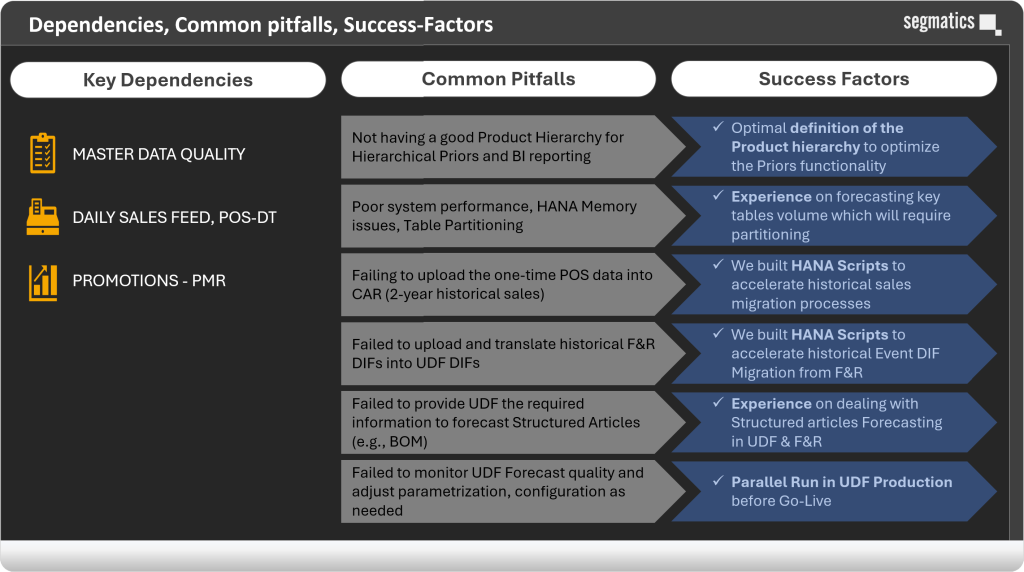
Just as important as these success factors are the pitfalls that repeatedly derail projects. Many retailers attempt to retrofit outdated or poorly defined processes into the new system, forcing customizations that undermine automation, create fragility, and replicate the very problems the project was meant to solve. Others focus too heavily on technical configuration while neglecting process governance, organization readiness, or parameter discipline. Poor master data remains one of the most damaging issues: weak product hierarchies disrupt hierarchical forecasting and BI reporting, missing lead times distort safety stock, and inconsistent vendor attributes degrade replenishment logic.
Additional technical risks include CAR table-partitioning issues, HANA memory constraints, and failing to load the required two years of POS history into CAR, reducing UDF forecast quality. Many teams also overlook the need to translate historical SAP F&R Demand-Influencing-Factors (DIFs) into UDF DIFs or fail to provide the structural data required for forecasting structured articles (e.g., Bill-Of-Materials). Without strong parameter governance, safety-stock settings, service levels, and replenishment rules drift over time, steadily eroding performance.
These pitfalls are predictable and avoidable. With strong preparation, governance, and cross-functional involvement, retailers can build the maturity required for high forecast accuracy, reliable automation, and sustained financial impact.
3. SAP’s Approach to Forecasting & Replenishment
SAP provides a modern, interconnected demand-management architecture anchored by two complementary solutions: SAP Forecasting & Replenishment (SAP F&R) and SAP CAR Unified Demand Forecast (UDF), supported by broader retail applications such as SAP Promotion Management for Retail (PMR), which enables the business integration layer mentioned above.
SAP Forecasting & Replenishment (SAP F&R)
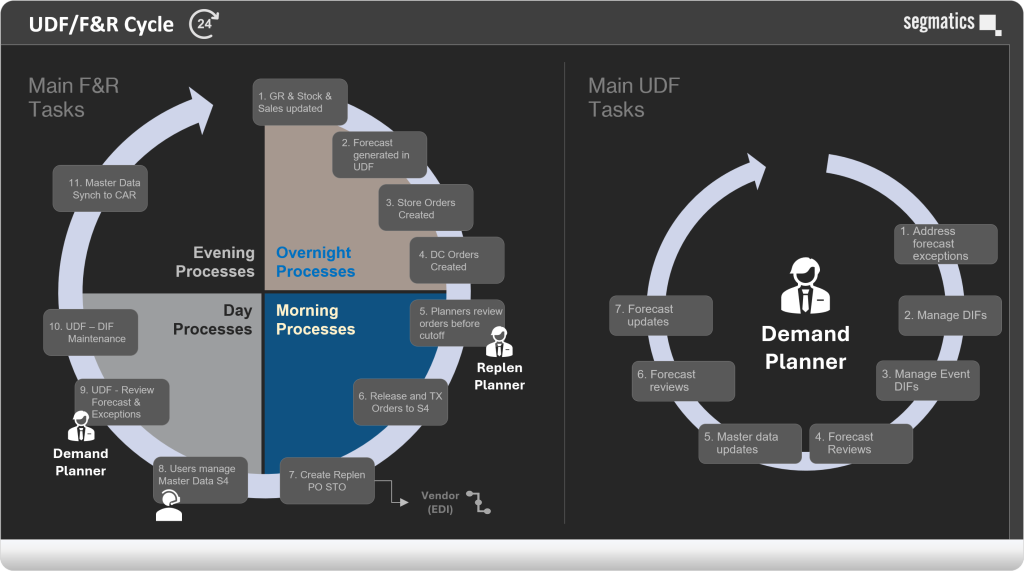
SAP F&R remains a mature and widely adopted replenishment platform for high-volume retail. It delivers stable, deterministic replenishment through solid parameterization of supply-chain constraints and robust exception management. Many retailers rely on SAP F&R as the backbone of automated ordering across stores and DCs.
SAP CAR Unified Demand Forecast (UDF)
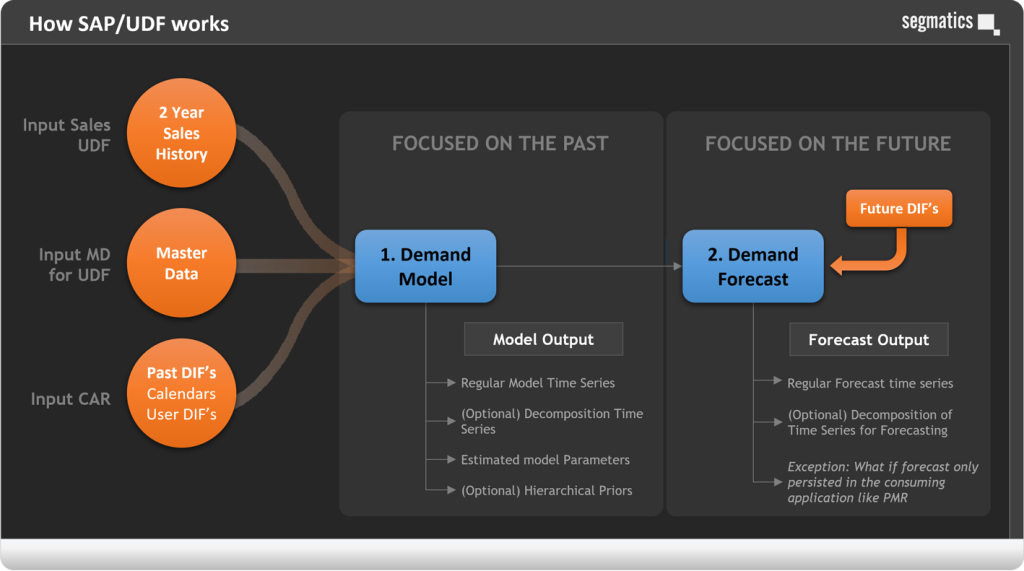
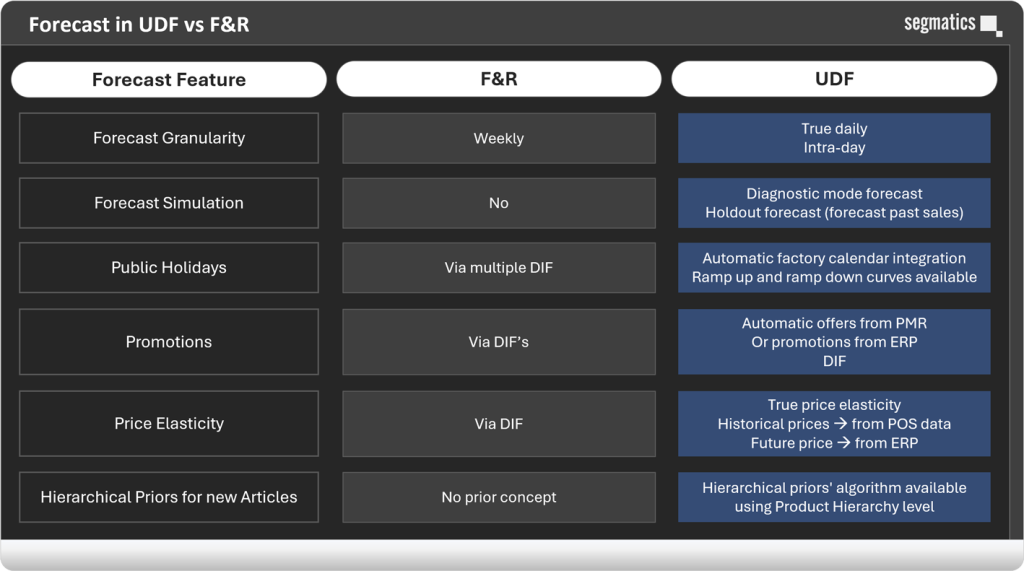
UDF, built within the Customer Activity Repository (CAR), represents SAP’s next-generation forecasting engine. It provides unified, machine-learning-driven demand signals across channels; advanced promotional and event modelling; and near–real-time processing of granular POS, inventory, and customer activity data, making it a strong fit for omnichannel environments and more volatile demand patterns.
SAP PMR (Promotion Management for Retail)
SAP PMR integrates merchandising and promotional planning into the demand signal by enabling retailers to manage promotional calendars, pricing actions, and in-store execution within the SAP retail suite. When connected to UDF and F&R, PMR ensures that promotional uplift and cannibalization are accurately reflected in the forecast and translated into replenishment quantities, aligning merchandising decisions with operational and financial plans.
Transition Path: F&R + UDF + PMR
Many retailers adopt a hybrid evolution path:
- Retaining SAP F&R for its strong replenishment automation
- Transitioning forecasting to UDF for improved accuracy and ML-based modelling
- Integrating PMR to ensure promotional decisions are fully connected to the demand plan
This architecture preserves the stability of the F&R replenishment engine while modernizing the forecasting layer and strengthening the link to merchandising, a future-proof approach that supports better availability, lower working capital, and improved promotional execution.
4. Our Implementation Approach
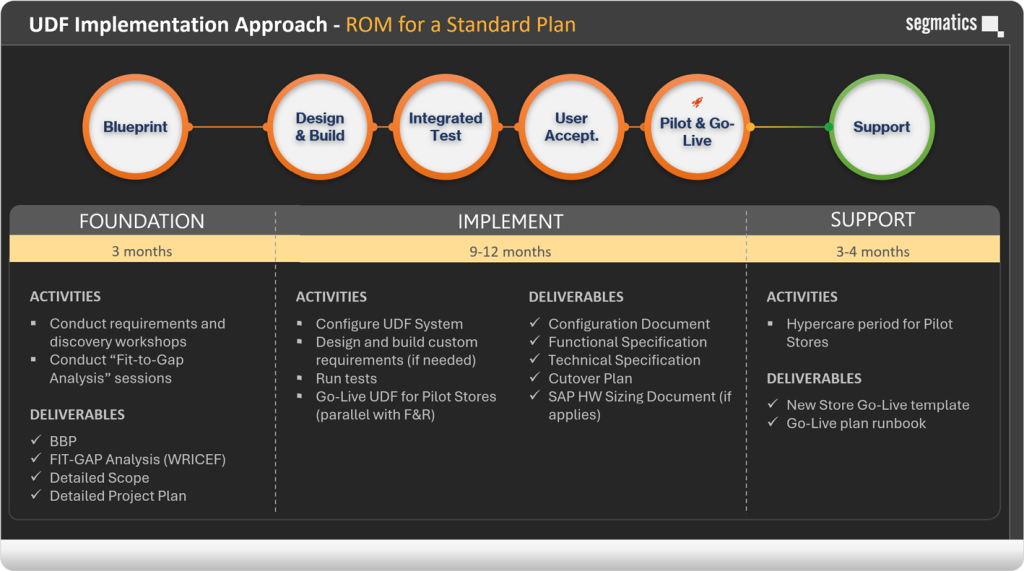
Our methodology blends SAP best practices with operational expertise across retail sectors.
We begin with discovery and education workshops to build foundational knowledge, define success metrics, and establish governance. We then design the blueprint for the future-state processes, balancing best practices with necessary customization.
Implementation includes configuration, integration testing, performance testing, and comprehensive user enablement with real-world scenarios emphasized. After launch, we support hypercare, tuning, and knowledge transfer, followed by an optimization roadmap to expand automation and introduce additional business applications where beneficial.
Complementing SAP with Our Business Intelligence Applications
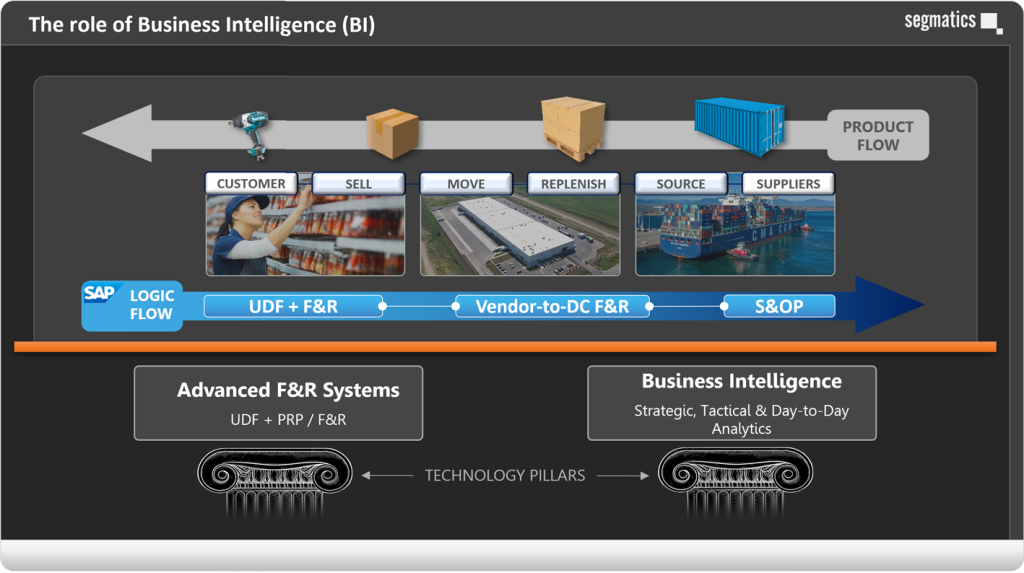
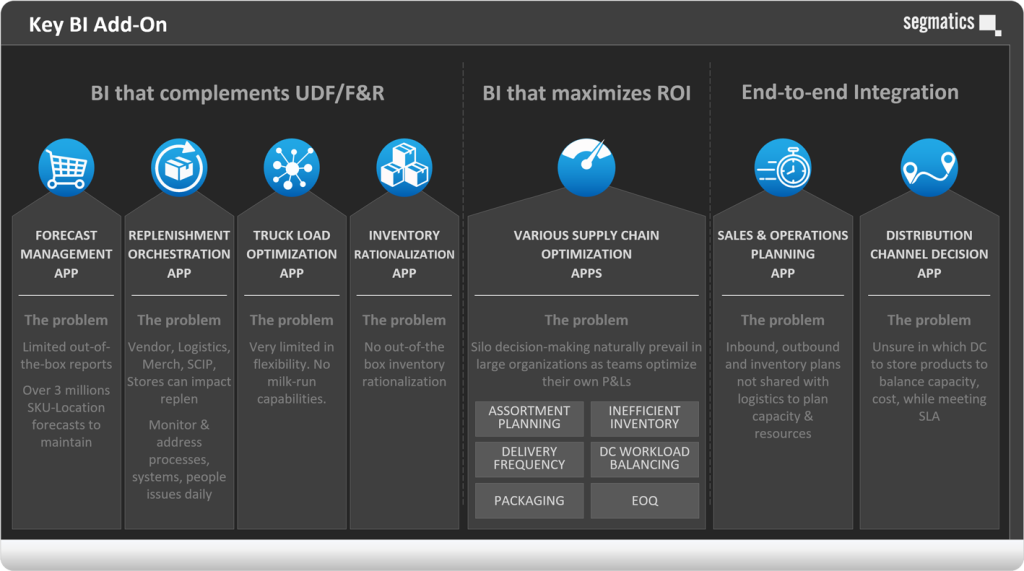
While modern F&R systems provide a critical pillar for demand fulfillment and integration, retailers often benefit from additional business-intelligence tools that automate repetitive work, accelerate decision-making, optimize system parameters, and orchestrate execution across the end-to-end value chain. We deploy applications that connect directly to SAP data, or to any other enterprise data source, to deliver these insights. Our applications provide real-time dashboards, automated parameter governance, enhanced promotion modelling, supplier-collaboration workflows, machine-learning extensions, and automated operational routines. These capabilities help retailers maximize the value of their forecast and replenishment systems without over-customizing the core platform
Our applications, designed to integrate seamlessly with SAP, enable:
- Real-time dashboards
- Automated parameter governance
- Enhanced promotion modelling
- Supplier-collaboration tools
- Machine-learning extensions
- Automated operational workflows
These tools help retailers maximize the value of their SAP investment without over-customizing the core.
Conclusion
As retail competition intensifies and volatility becomes the norm, modern forecasting and replenishment practices are essential to operational excellence. SAP’s CAR UDF represents a significant step forward in predictive accuracy, scalability, and integration, while SAP F&R remains a powerful and reliable replenishment engine.
But true performance comes from more than technology, it relies on disciplined processes, strong governance, transparent data, organizational alignment, and continuous improvement.
Our implementation methodology and business applications help retailers build maturity, unlock automation, and deliver measurable improvements in availability, inventory productivity, cash-flow efficiency, and operational performance.
If your organization is exploring SAP F&R modernization, CAR UDF adoption, or opportunities to elevate your forecasting and replenishment framework, we are ready to support your journey.